_edited_edited_edited_edited.png)
The Pathway that Changes What Exercise Does to Your Chronic Pain

Updated: Jul 16
A whole-person approach for people who have tried and found exercise doesn't help

Think back to the first time you remember exercising. What do you remember? Was it fun, hard, something you looked forward to, or something you dreaded?
Think back to the first time you remember exercising. What do you remember? Was it fun, hard, something you looked forward to, or something you dreaded?
Our experiences shape what we believe is possible. And when it comes to exercise, those early experiences, and the ones since, have been quietly building something in the relationship between your brain, your body, and your heart. When pain enters the picture, those connections are complicated even further. Exercising with chronic pain is anything but straightforward.
Whether exercise feels like a resource or a burden, a relief or a punishment, whether you do it or know you should, it has been building either a bridge or a wall between the parts of your whole person. And that, as it turns out, has a profound downstream effect on healing, health, and the habits that support both.
This isn't a philosophical idea. It's a physiological one, and it's something I've come to see as central to why exercise either delivers its extraordinary benefits or quietly works against the very things we hope it will do.
Two Facts About Living in a Human Body
Whatever your history with exercise, two physiological facts apply to all of us.
The first is that the body is a use-it-to-keep-it system. Strength, stamina, and mobility don't maintain themselves. Without intentional movement, we gradually lose the physical skills needed to do what we love with the people we love. No medication, supplement, or amount of rest replaces what exercise does for the body over time. This is not meant to add pressure. It's actually good news, because it means you can start using it again and for the most part, get it back. The key is doing intentional movement that starts at the lightest level. The problem is, our culture often promotes intensity over intentionality and has forgotten that gradual is powerful.
The second fact is that stress puts the body in a ready-to-move state. The brain signals the body to be ready to fight, flee, or freeze. Most ordinary physical activity, the tasks of daily life, does not clear that ready-to-move tension. Only intentional, science-guided movement has the chance to use that stress tension in a way that releases it. This is why exercise, which literaly means intentional movement, when aligned with how the body is designed to move well before moving more, is one of the most powerful tools we have for moving from the stress state to the well state. What's amazing is when what and how you move is aligned with these principles, you get a two for one; turn stress tension into mobility, strength and stamina to do more of what you love with those you love.
In my years working with people in pain and managing chronic conditions, I've come to understand how our cultural ideas about what counts as exercise has left them out of this two for one benefit. Instead, even the word exercise adds to stress rather than offers a way to calm it and spiral up all at the same time. The answer is not found in modifications or motivational speeches, it's found in physiology because the body sends more signals to the brain than the brain to the body.
Two States That Determine Everything
The body operates in two fundamental physiological states.
In the stress state, the body perceives a threat, real or imagined, and redirects its energy toward protection. Healing and repair is slowed. Muscles hold tension. For someone already living with pain, this is often the state that pain keeps the body locked into before exercise even begins.
In the well state, the body feels safe enough to rest, repair, and grow. Energy moves toward restoration. The nervous system can learn, adapt, and respond with its full range of function.
Every health benefit we associate with exercise, reduced inflammation, improved mood, better metabolic function, stronger muscles and bones, happens most effectively when the body is in, or moving toward, the well state. When exercise is done from the stress state, those same movements produce a different physiological outcome. The body is directing energy toward protection rather than restoration. Movement under those conditions adds load to a system already under strain.
In my work, this distinction makes all the difference. It separates exercise that gradually builds someone's capacity to move with more ease and less pain from exercise that leaves them hurting more and trusting their body less. It determines whether someone spirals upward, restoring and keeping the abilities that give life meaning, or spirals slowly downward, quietly losing the activities that once brought them joy.
It all begins with how exercise is experienced, whether it connects or disconnects the brain from the body and heart.
The Bridge or the Barrier
A bridge is built when exercise is motivated by something genuinely meaningful, what I call your Core Why: the one word that clarifies to your brain why investing energy here is worth it. When that connection is real, the brain recognizes exercise not as a demand but as a return on investment toward what matters most.
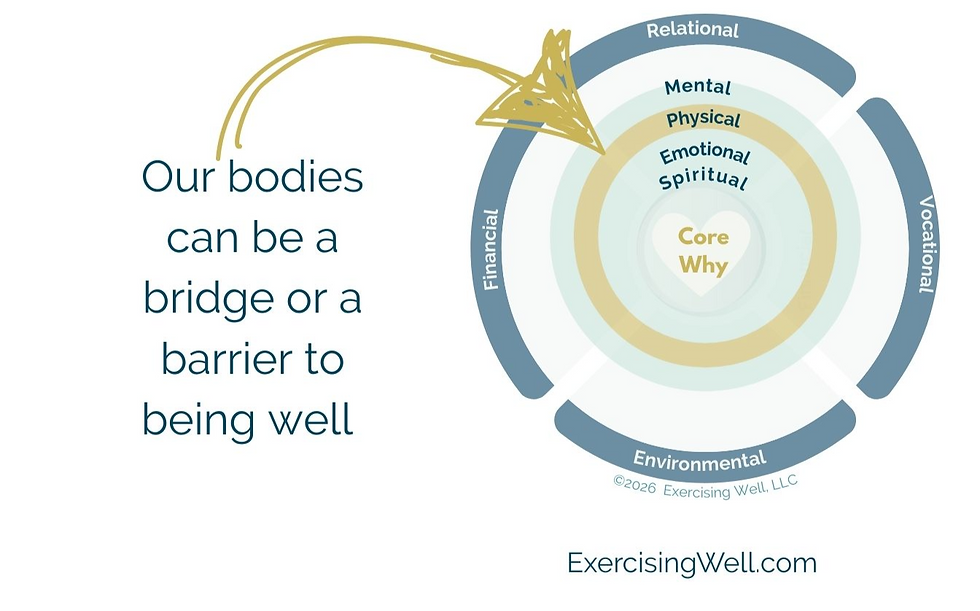
A bridge is also built through movement that follows the body's design. When exercise is guided by movement science principles, the body sends a clear signal to the brain: this is safe, this is good, do this again. When exercise feels like care, whether it is light or challenging, when you finish and feel more resourced than depleted, that is exercise in the well state. And the brain is wired to return to what feels that way.
A wall is built, gradually and often without realizing it, when exercise requires overriding what the body is telling you. When the motivation is fear of what will happen if you stop. When pain is something to push past rather than pay attention to. When you have to distract yourself to get through it. When you finish with nothing left for the people and things that matter in your daily life.
Most people living with physical pain, or the emotional weight of a long difficult history with exercise, have experienced far more of the second than the first. And over time, the wall gets higher. The body becomes something to fear and manage rather than a source of guidance. The gap between wanting to exercise and being able to get yourself to do it grows wider.
Is Exercise Building a Bridge to Your Body? Or a Wall Between You?
What I've found, and what the research on pain, movement, and the nervous system continues to confirm, is that this wall is not permanent. The bridge can be rebuilt. It requires a different approach, but it is entirely possible, even for people who have given up on the idea that exercise could ever feel good again.
What Bridge-Building Exercise Opens Up, Especially for Chronic Pain
When exercise is defined as intentional movement done in alignment with the body's design, three things become accessible that are genuinely harder to reach from the stress state.
Healing. In the well state, the body's energy moves toward repair and restoration. Healing does not mean curing. It means optimizing the body's ongoing capacity to protect, repair, and adapt. This is a lifelong process, and the moments when we need it most, when pain is higher, when a condition is flaring, when stress has been sustained and long, are exactly when knowing how to shift from stress to well matters most.
Habits. We are wired to repeat what feels good and avoid what does not. This is not a character flaw. It is the mechanism behind every habit ever formed. Exercise that consistently leaves the body feeling better signals the brain to return. That signal is the foundation of a genuine, self-sustaining habit, one that does not require willpower to maintain because the body itself is asking for it.
Health. Health is not a destination. It is an ongoing process of choosing, as consistently as possible, the actions that support the body's shift from stress to well. When exercise is one of those actions, it does not just contribute to health directly. It strengthens the body's connection to its own signals and its own capacity for self-care, which supports eating well, managing stress, and resting more effectively too.
The Starting Point That Changes Everything
There is a kind of exercise advice that skips all of this. It starts with what to do and how much: which movements, how often, how hard. That information matters, and there is a place for it. But for anyone whose body carries pain, fear of injury, or a history of exercise that has not helped, starting there misses the step that makes everything else possible.
That first step is helping the brain understand why investing energy in movement is worth it. The first question is not what exercise to do. It is how to arrive at movement in a way the nervous system can receive as safe rather than as one more demand.
This is what the Be Well Now Method is built around. Not a better program, but a better starting point. One that restores exercise to what it was always designed to be: the most direct, accessible, in-the-moment way to shift your whole person from stress to well, so you can do more of what you love, with the people you love, for as long as possible.
When exercise does that, it is not just a health habit. It is the foundation for living better and enjoying life more.
What would become possible in your life if exercise felt genuinely helpful, not like one more thing to push through? If it actually reduced your pain and stress instead of adding to them? If it was flexible enough to fit into your real life, consistently? What would that open up for you?
If you're curious about your starting point, the Core Why questions are a free first step. The link is below.
Sources
Vlaeyen JWS, Linton SJ. Fear-avoidance and its consequences in chronic musculoskeletal pain: a state of the art. Pain. 2000;85(3):317–332.
Gleeson M, Bishop NC, Stensel DJ, Lindley MR, Mastana SS, Nimmo MA. The anti-inflammatory effects of exercise: mechanisms and implications for the prevention and treatment of disease. Nature Reviews Immunology. 2011;11(9):607–615.
Roberts RL, Ledermann K, Garland EL. Changes in interoception in mind-body therapies for chronic pain: a systematic review and meta-analysis. International Journal of Behavioral Medicine. 2024;31(1):1–15.
Teixeira PJ, Carraça EV, Markland D, Silva MN, Ryan RM. Exercise, physical activity, and self-determination theory: a systematic review. International Journal of Behavioral Nutrition and Physical Activity. 2012;9:78.
Luu NS, Taube A, Nielsen L, Ljungman P, Uhlin M. Exercise duration modulates cortisol release and chronic cortisol exposure jeopardises T cell effector functions. Immunology. 2026;167(1):e70028.


Comments